
Product Usage: This PRODUCT IS INTENDED AS A RESEARCH CHEMICAL ONLY. This designation allows the use of research chemicals strictly for in vitro testing and laboratory experimentation only. All product information available on this website is for educational purposes only. Bodily introduction of any kind into humans or animals is strictly forbidden by law. This product should only be handled by licensed, qualified professionals. This product is not a drug, food, or cosmetic and may not be misbranded, misused or mislabeled as a drug, food or cosmetic.
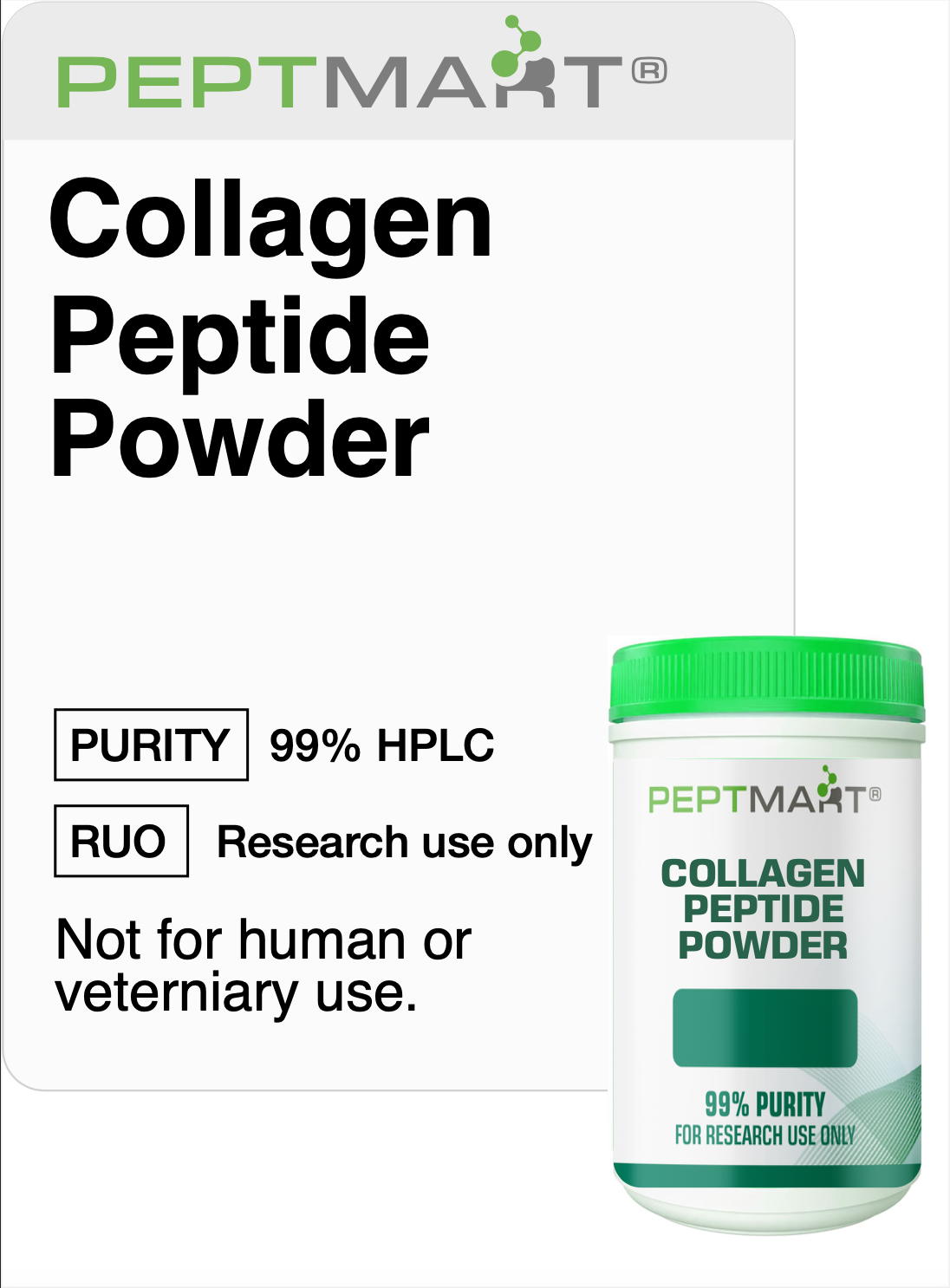
Collagen peptide
$24.99
Collagen peptide
Collagen peptide acts as a building block of larger collagen molecules. In so doing, it can change, by virtue of its amino acid sequence and relative frequency with the collagen superstructure, the tertiary and quaternary properties of a collagen molecule. It is important to remember that collagen is not just a structural protein, but also plays roles in cell adhesion, tissue regulation, and healing.
$24.99
Peptides will arrive in a lyophilized (powder) form for maximum stability
Collagen peptide
Collagen peptide is a synthetic mimic of one of the basic building blocks of collagen. Collagen is a long-chain polymer made of short monomeric repeats that are generally made up of three amino acids in sequence. These repeats bond together to create secondary structures, which then combine to form tertiary and even quaternary structures. These complex structures have many emergent properties that the peptide subunits don’t possess. However, changing the nature of the peptide subunits can change the ultimate properties of a quaternary collage compound. Collagen subunits almost always follow the pattern of Gly-Pro-X or Gly-X-Hyp. Tripeptide-29 is a Gly-Pro-Hyp peptide, making it a perfect synthetic analogue of common collage building blocks.
Collagen peptide
Chemical Formula: C12H19N3O5
Molecular Weight: 285.3 g/mol
Amino Acid Sequence: Gly-Pro-Hyp
What Is Collagen peptide?
Collagen peptide is a synthetic analogue of a collage building block. The three-amino-acid long peptide mimics the common Gly-Pro-X/Gly-X-Hyp format of collagen subunits.
What Does Collagen peptide Do?
Fundamentally, Collagen peptide acts as a building block of larger collagen molecules. In so doing, it can change, by virtue of its amino acid sequence and relative frequency with the collagen superstructure, the tertiary and quaternary properties of a collagen molecule. It is important to remember that collagen is not just a structural protein, but also plays roles in cell adhesion, tissue regulation, and healing. Thus, Collagen peptide has the potential to impact a multitude of physiologic features.
The Roles of Collagen
To be clear, collagen is one of the most ubiquitous molecules in the animal kingdom. It is found in humans, all mammals, reptiles, fish, birds, and even algae. Collage plays roles in:
Tendon and ligament structure,
Skin,
Vascular walls,
Cornea of the eye,
Muscle fibers,
Bone,
Teeth,
Scar formation,
Vitreous humour of the eye,
Placental structure,
Cartilage,
Transmembrane proteins like integrin and fibronectin, and
Cell signaling.
Collagen peptide Research
In vitro research into Collagen peptide has revealed that the peptide, in its non-polymerized form, is a partial agonists of the collagen receptor GPVI[1]. GPVI is expressed on the surface of platelets, the cell-like structures responsible for the early formation of blood clots. The GPVI receptor plays a crucial role in the collagen-induced activation of platelet aggregation in vascular tissue, a first step to clot formation and tissue repair. Thus, collagen fibers are generally considered thrombogenic.
When dysregulated, collagen thrombogenesis may lead to the development of blood clots. Interestingly, crosslinking of tripeptide-29 appears to boost GPVI activation, suggesting that the peptide could be useful in understanding how to create a “just-right” clotting environment in the setting of various bleeding/clotting disorders.
Collagen peptide and Collagen Stability
Benchtop research into the role of short peptides like Collagen peptide has revealed that they can be used to modulate the stability of collagen. Collagen peptide, in particular, has helped scientists to understand that the ultimate structure of collagen is influenced most by the last peptide in a tripeptide monomer. In a monomer of A-B-C, it is the peptide in the C position that has most influence on final collagen stability[2]. This finding could help scientists to one day create synthetic implants for cartilage, bone, teeth, and more.
Collagen and Free Radical Damage
Free radical damage is the primary cause of cellular and tissue aging. The body has a number of defenses against free radical damage, but they all become less effective over time. Research in sea cucumber has revealed that collagen hydrolysates constructed from monomers like tripeptide-29 are effective radical scavengers, and that the structure of the tripeptide monomer can affect scavenger activity. No research has been carried out on Tripeptide 29, yet, but there is interest in determining how such peptides could be used in foods and nutraceutical products[3].
Collagen peptide Regulates Tissue Fibrosis
In vitro studies of pig skin, cattle skin, fish scales, and chick feet have revealed that Collagen peptide is an inhibitor of dipeptidylpeptidase-IV activity[4], [5]. Dipeptidylpeptidase-IV (DPP4) is an enzyme found mostly in cells associated with immune signaling and cell apoptosis. It is an intrinsic part of the cell membrane and indiscriminately destroys growth factors, chemokines, neuropeptides, and vasoactive peptides. It also plays a large role in glucose metabolism by breaking down incretins, hormones that stimulate a decrease in blood glucose levels.
Animal studies have revealed that DPP4 plays a role in the development of fibrosis in organs that include the kidney and liver[5]. Inhibiting the enzyme thus prevents scarring in disease processes that affect these organs. Collagen peptide maybe doubly beneficial in this setting, as diabetes is a prime cause of kidney fibrosis. The ability of Collagen peptide to stimulate glucose uptake and reduce fibrosis, both by inhibiting DPP4, opens a number of research avenues in the control of not just diabetes, but its pathologic sequelae as well.
Collagen peptide and Skin Tone
There is recent interest in the role of Collagen peptide and other tripeptides in protecting skin against the normal process of aging. Research in animals suggests that topical use of tripeptides can reduce the visible effects of skin aging by improving contour, reducing skin deformation, and boosting hydration. There is also evidence that tripeptides can smooth skin texture and reduce the appearance of brown and red spots. In fact, 90% of subjects in the study showed improved moisturization of the skin in addition to increased flexibility secondary to improve elasticity[6].
When combined with certain hexapeptides, topical tripeptide-29 can boost skin turnover and reduce fine lines, crow’s feet, under eye bags, and eye hollowing. In these animal studies, roughly 50% of subjects showed improved skin appearance with twice daily application of the peptide paste[7].
Referenced Citations
- J. Asselin, C. G. Knight, R. W. Farndale, M. J. Barnes, and S. P. Watson, “Monomeric (glycine-proline-hydroxyproline)10 repeat sequence is a partial agonist of the platelet collagen receptor glycoprotein VI,” Biochem. J., vol. 339 ( Pt 2), pp. 413–418, Apr. 1999.
- K. Mizuno, D. H. Peyton, T. Hayashi, J. Engel, and H. P. Bächinger, “Effect of the -Gly-3(S)-hydroxyprolyl-4(R)-hydroxyprolyl- tripeptide unit on the stability of collagen model peptides,” FEBS J., vol. 275, no. 23, pp. 5830–5840, Dec. 2008.
- M. Z. Abedin et al., “Biochemical and radical-scavenging properties of sea cucumber (Stichopus vastus) collagen hydrolysates,” Nat. Prod. Res., vol. 28, no. 16, pp. 1302–1305, 2014.
- T. Hatanaka, K. Kawakami, and M. Uraji, “Inhibitory effect of collagen-derived tripeptides on dipeptidylpeptidase-IV activity,” J. Enzyme Inhib. Med. Chem., vol. 29, no. 6, pp. 823–828, Dec. 2014.
- H. S. Min et al., “Dipeptidyl peptidase IV inhibitor protects against renal interstitial fibrosis in a mouse model of ureteral obstruction,” Lab. Investig. J. Tech. Methods Pathol., vol. 94, no. 6, pp. 598–607, Jun. 2014.
- A. Garre, G. Martinez-Masana, J. Piquero-Casals, and C. Granger, “Redefining face contour with a novel anti-aging cosmetic product: an open-label, prospective clinical study,” Clin. Cosmet. Investig. Dermatol., vol. 10, pp. 473–482, 2017.
- A. Reivitis, K. Karimi, C. Griffiths, and A. Banayan, “A single-center, pilot study evaluating a novel TriHex peptide- and botanical-containing eye treatment compared to baseline,” J. Cosmet. Dermatol., vol. 17, no. 3, pp. 467–470, Jun. 2018.
Collagen peptide is a synthetic collagen-like tripeptide composed of Hydroxyproline, Proline, Glycine. CAS No. 2239-67-0 Water Content: <5% Sequence: Gly-Pro-Hyp Molecular Formula: C12H19N3O5 Molecular Weight: 285.3
ALL ARTICLES AND PRODUCT INFORMATION PROVIDED ON THIS WEBSITE ARE FOR INFORMATIONAL AND EDUCATIONAL PURPOSES ONLY.
The products offered on this website are furnished for in-vitro studies only. In-vitro studies (Latin: in glass) are performed outside of the body. These products are not medicines or drugs and have not been approved by the FDA to prevent, treat or cure any medical condition, ailment or disease. Bodily introduction of any kind into humans or animals is strictly forbidden by law.
STORAGE INSTRUCTIONS:
All of Our Products are manufactured using the Lyophilization (Freeze Drying) process, which ensures that our products remain 100% stable for shipping for up to 24-36 month.
Once the peptides are reconstituted (mixed with bacteriostatic water), they just be stored in the fridge to maintain stability After reconstitution, the peptides will remain stable for up to 30 days.
Lyophilization is a unique dehydration process, also known as cryodesiccation, where the peptides are frozen and then subjected to low pressure. This causes the water in the peptide vial to sublimate directly from solid to gas, leaving behind a stable, crystalline white structure known as lyophilized peptide The puffy white powder can be stored at room temperature until you’re ready to reconstitute it with bacteriostatic water.
Once peptides have been received, it is imperative that they are kept cold and away from light. If the peptides will be used immediately, or in the next several days, weeks or months short-term refrigeration under 4c (39F) is generally acceptable. Lyophilized peptides are usually stable at room temperatures for several weeks or more, so if they will be utilized within weeks or months such storage is typically adequate.
However, for longer term storage (several months to years) it is more preferable to store peptides in a freezer at -80C (-112F).
When storin peptides for months or even years, freezing is optimal in order to preserve the peptide’s stability.


Dermorphin
10mg
Insulin
Long Lasting 3mg
Fast Acting 3mg
Somatropin HGH
10iu
15iu
AOD 9604
2mg
5mg
ВРС 157
2mg
5mg
10mg
NAD+
100mg
500mg
1000mg
Retatruitide
5mg
10mg
15mg
20mg
Tirz
5mg
10mg
20mg
30mg
40mg
50mg
60mg
Viagra
100mg (30 Pills)
Mots C
10mg
Cagri
10mg
Lipo C
10mg
Kisspeptin-10
5mg
Semax
10mg
Collagen Peptide Powder
9.330z
Collagen peptide
Collagen peptide is a synthetic mimic of one of the basic building blocks of collagen. Collagen is a long-chain polymer made of short monomeric repeats that are generally made up of three amino acids in sequence. These repeats bond together to create secondary structures, which then combine to form tertiary and even quaternary structures. These complex structures have many emergent properties that the peptide subunits don’t possess. However, changing the nature of the peptide subunits can change the ultimate properties of a quaternary collage compound. Collagen subunits almost always follow the pattern of Gly-Pro-X or Gly-X-Hyp. Tripeptide-29 is a Gly-Pro-Hyp peptide, making it a perfect synthetic analogue of common collage building blocks.
Collagen peptide
Chemical Formula: C12H19N3O5
Molecular Weight: 285.3 g/mol
Amino Acid Sequence: Gly-Pro-Hyp
What Is Collagen peptide?
Collagen peptide is a synthetic analogue of a collage building block. The three-amino-acid long peptide mimics the common Gly-Pro-X/Gly-X-Hyp format of collagen subunits.
What Does Collagen peptide Do?
Fundamentally, Collagen peptide acts as a building block of larger collagen molecules. In so doing, it can change, by virtue of its amino acid sequence and relative frequency with the collagen superstructure, the tertiary and quaternary properties of a collagen molecule. It is important to remember that collagen is not just a structural protein, but also plays roles in cell adhesion, tissue regulation, and healing. Thus, Collagen peptide has the potential to impact a multitude of physiologic features.
The Roles of Collagen
To be clear, collagen is one of the most ubiquitous molecules in the animal kingdom. It is found in humans, all mammals, reptiles, fish, birds, and even algae. Collage plays roles in:
Tendon and ligament structure,
Skin,
Vascular walls,
Cornea of the eye,
Muscle fibers,
Bone,
Teeth,
Scar formation,
Vitreous humour of the eye,
Placental structure,
Cartilage,
Transmembrane proteins like integrin and fibronectin, and
Cell signaling.
Collagen peptide Research
In vitro research into Collagen peptide has revealed that the peptide, in its non-polymerized form, is a partial agonists of the collagen receptor GPVI[1]. GPVI is expressed on the surface of platelets, the cell-like structures responsible for the early formation of blood clots. The GPVI receptor plays a crucial role in the collagen-induced activation of platelet aggregation in vascular tissue, a first step to clot formation and tissue repair. Thus, collagen fibers are generally considered thrombogenic.
When dysregulated, collagen thrombogenesis may lead to the development of blood clots. Interestingly, crosslinking of tripeptide-29 appears to boost GPVI activation, suggesting that the peptide could be useful in understanding how to create a “just-right” clotting environment in the setting of various bleeding/clotting disorders.
Collagen peptide and Collagen Stability
Benchtop research into the role of short peptides like Collagen peptide has revealed that they can be used to modulate the stability of collagen. Collagen peptide, in particular, has helped scientists to understand that the ultimate structure of collagen is influenced most by the last peptide in a tripeptide monomer. In a monomer of A-B-C, it is the peptide in the C position that has most influence on final collagen stability[2]. This finding could help scientists to one day create synthetic implants for cartilage, bone, teeth, and more.
Collagen and Free Radical Damage
Free radical damage is the primary cause of cellular and tissue aging. The body has a number of defenses against free radical damage, but they all become less effective over time. Research in sea cucumber has revealed that collagen hydrolysates constructed from monomers like tripeptide-29 are effective radical scavengers, and that the structure of the tripeptide monomer can affect scavenger activity. No research has been carried out on Tripeptide 29, yet, but there is interest in determining how such peptides could be used in foods and nutraceutical products[3].
Collagen peptide Regulates Tissue Fibrosis
In vitro studies of pig skin, cattle skin, fish scales, and chick feet have revealed that Collagen peptide is an inhibitor of dipeptidylpeptidase-IV activity[4], [5]. Dipeptidylpeptidase-IV (DPP4) is an enzyme found mostly in cells associated with immune signaling and cell apoptosis. It is an intrinsic part of the cell membrane and indiscriminately destroys growth factors, chemokines, neuropeptides, and vasoactive peptides. It also plays a large role in glucose metabolism by breaking down incretins, hormones that stimulate a decrease in blood glucose levels.
Animal studies have revealed that DPP4 plays a role in the development of fibrosis in organs that include the kidney and liver[5]. Inhibiting the enzyme thus prevents scarring in disease processes that affect these organs. Collagen peptide maybe doubly beneficial in this setting, as diabetes is a prime cause of kidney fibrosis. The ability of Collagen peptide to stimulate glucose uptake and reduce fibrosis, both by inhibiting DPP4, opens a number of research avenues in the control of not just diabetes, but its pathologic sequelae as well.
Collagen peptide and Skin Tone
There is recent interest in the role of Collagen peptide and other tripeptides in protecting skin against the normal process of aging. Research in animals suggests that topical use of tripeptides can reduce the visible effects of skin aging by improving contour, reducing skin deformation, and boosting hydration. There is also evidence that tripeptides can smooth skin texture and reduce the appearance of brown and red spots. In fact, 90% of subjects in the study showed improved moisturization of the skin in addition to increased flexibility secondary to improve elasticity[6].
When combined with certain hexapeptides, topical tripeptide-29 can boost skin turnover and reduce fine lines, crow’s feet, under eye bags, and eye hollowing. In these animal studies, roughly 50% of subjects showed improved skin appearance with twice daily application of the peptide paste[7].
Referenced Citations
- J. Asselin, C. G. Knight, R. W. Farndale, M. J. Barnes, and S. P. Watson, “Monomeric (glycine-proline-hydroxyproline)10 repeat sequence is a partial agonist of the platelet collagen receptor glycoprotein VI,” Biochem. J., vol. 339 ( Pt 2), pp. 413–418, Apr. 1999.
- K. Mizuno, D. H. Peyton, T. Hayashi, J. Engel, and H. P. Bächinger, “Effect of the -Gly-3(S)-hydroxyprolyl-4(R)-hydroxyprolyl- tripeptide unit on the stability of collagen model peptides,” FEBS J., vol. 275, no. 23, pp. 5830–5840, Dec. 2008.
- M. Z. Abedin et al., “Biochemical and radical-scavenging properties of sea cucumber (Stichopus vastus) collagen hydrolysates,” Nat. Prod. Res., vol. 28, no. 16, pp. 1302–1305, 2014.
- T. Hatanaka, K. Kawakami, and M. Uraji, “Inhibitory effect of collagen-derived tripeptides on dipeptidylpeptidase-IV activity,” J. Enzyme Inhib. Med. Chem., vol. 29, no. 6, pp. 823–828, Dec. 2014.
- H. S. Min et al., “Dipeptidyl peptidase IV inhibitor protects against renal interstitial fibrosis in a mouse model of ureteral obstruction,” Lab. Investig. J. Tech. Methods Pathol., vol. 94, no. 6, pp. 598–607, Jun. 2014.
- A. Garre, G. Martinez-Masana, J. Piquero-Casals, and C. Granger, “Redefining face contour with a novel anti-aging cosmetic product: an open-label, prospective clinical study,” Clin. Cosmet. Investig. Dermatol., vol. 10, pp. 473–482, 2017.
- A. Reivitis, K. Karimi, C. Griffiths, and A. Banayan, “A single-center, pilot study evaluating a novel TriHex peptide- and botanical-containing eye treatment compared to baseline,” J. Cosmet. Dermatol., vol. 17, no. 3, pp. 467–470, Jun. 2018.
Collagen peptide is a synthetic collagen-like tripeptide composed of Hydroxyproline, Proline, Glycine. CAS No. 2239-67-0 Water Content: <5% Sequence: Gly-Pro-Hyp Molecular Formula: C12H19N3O5 Molecular Weight: 285.3
ALL ARTICLES AND PRODUCT INFORMATION PROVIDED ON THIS WEBSITE ARE FOR INFORMATIONAL AND EDUCATIONAL PURPOSES ONLY.
The products offered on this website are furnished for in-vitro studies only. In-vitro studies (Latin: in glass) are performed outside of the body. These products are not medicines or drugs and have not been approved by the FDA to prevent, treat or cure any medical condition, ailment or disease. Bodily introduction of any kind into humans or animals is strictly forbidden by law.
STORAGE INSTRUCTIONS:
All of Our Products are manufactured using the Lyophilization (Freeze Drying) process, which ensures that our products remain 100% stable for shipping for up to 24-36 month.
Once the peptides are reconstituted (mixed with bacteriostatic water), they just be stored in the fridge to maintain stability After reconstitution, the peptides will remain stable for up to 30 days.
Lyophilization is a unique dehydration process, also known as cryodesiccation, where the peptides are frozen and then subjected to low pressure. This causes the water in the peptide vial to sublimate directly from solid to gas, leaving behind a stable, crystalline white structure known as lyophilized peptide The puffy white powder can be stored at room temperature until you’re ready to reconstitute it with bacteriostatic water.
Once peptides have been received, it is imperative that they are kept cold and away from light. If the peptides will be used immediately, or in the next several days, weeks or months short-term refrigeration under 4c (39F) is generally acceptable. Lyophilized peptides are usually stable at room temperatures for several weeks or more, so if they will be utilized within weeks or months such storage is typically adequate.
However, for longer term storage (several months to years) it is more preferable to store peptides in a freezer at -80C (-112F).
When storin peptides for months or even years, freezing is optimal in order to preserve the peptide’s stability.