
Product Usage: This PRODUCT IS INTENDED AS A RESEARCH CHEMICAL ONLY. This designation allows the use of research chemicals strictly for in vitro testing and laboratory experimentation only. All product information available on this website is for educational purposes only. Bodily introduction of any kind into humans or animals is strictly forbidden by law. This product should only be handled by licensed, qualified professionals. This product is not a drug, food, or cosmetic and may not be misbranded, misused or mislabeled as a drug, food or cosmetic.
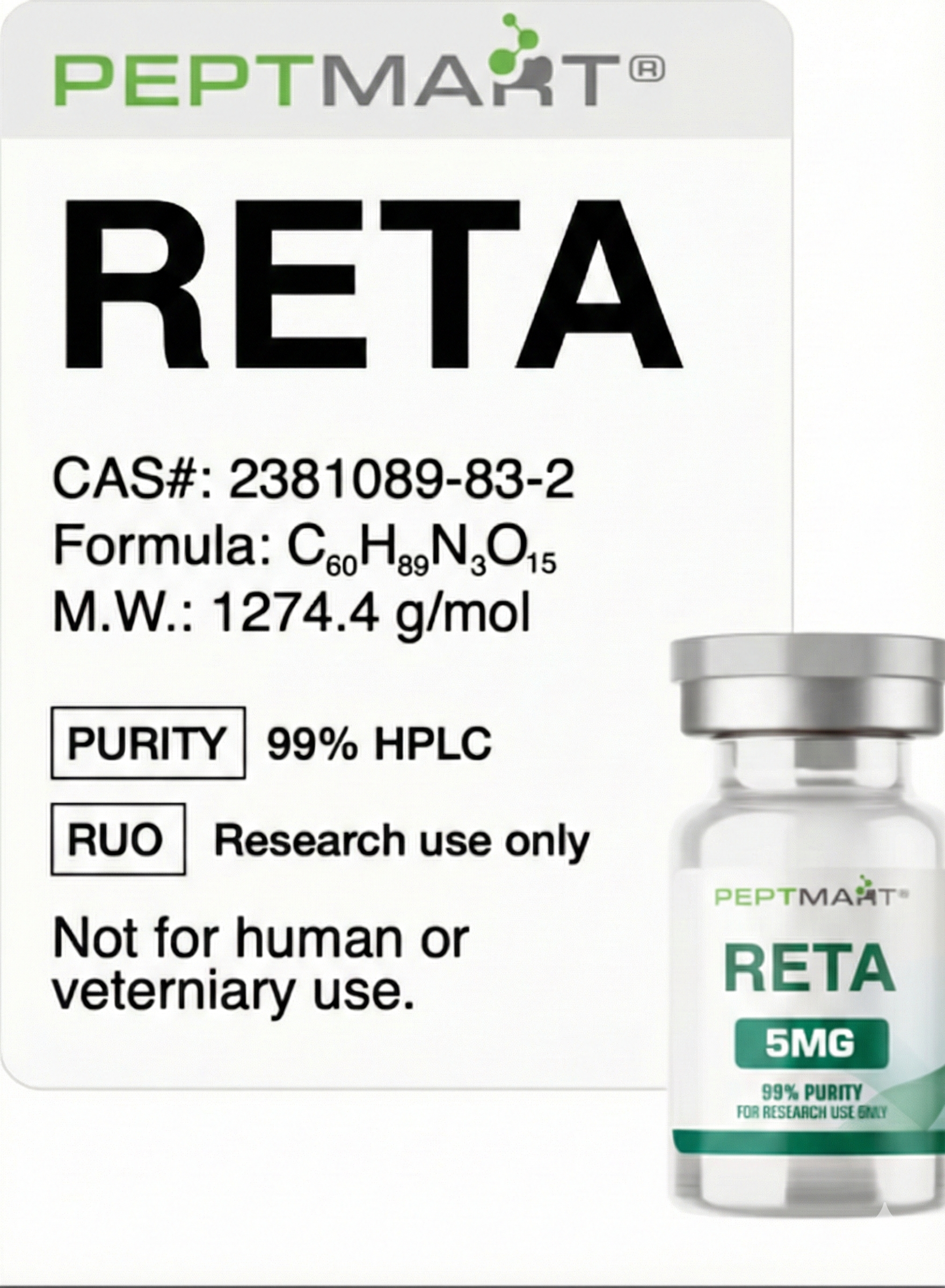
Reta 5mg
$64.99
Reta 5mg
Reta is a GGG tri-agonist that targets GLP-1 and GIP receptors, akin to standard GLP-1 agonists, but also uniquely activates the glucagon receptor. This extra receptor interaction enhances glucagon production, leading to the breakdown of stored fats and glycogen, thereby increasing basal metabolism for more consistent fat loss. Its actions on GLP-1 and GIP receptors promote delayed gastric emptying and appetite control, offering a comprehensive approach to obesity research distinct from older GLP-1 agonists. Further research is required.
$64.99
Peptides will arrive in a lyophilized (powder) form for maximum stability
Dermorphin
10mg
Insulin
Long Lasting 3mg
Fast Acting 3mg
Somatropin HGH
10iu
15iu
AOD 9604
2mg
5mg
ВРС 157
2mg
5mg
10mg
NAD+
100mg
500mg
1000mg
Retatruitide
5mg
10mg
15mg
20mg
Tirz
5mg
10mg
20mg
30mg
40mg
50mg
60mg
Viagra
100mg (30 Pills)
Mots C
10mg
Cagri
10mg
Lipo C
10mg
Kisspeptin-10
5mg
Semax
10mg
Collagen Peptide Powder
9.330z
GLP-3 Overview
GLP-3 is an investigational GGG tri-agonist peptide studied for activity at the
glucagon-like peptide-1 receptor (GLP-1R), glucose-dependent insulinotropic
polypeptide receptor (GIPR), and glucagon receptor (GCGR).
Its multi-receptor pharmacology makes it a subject of ongoing laboratory research
involving incretin signaling, receptor selectivity, peptide engineering,
pharmacokinetics, and metabolic pathway analysis.
GLP-3 Structure
- Sequence: YA1QGTFTSDYSIL2LDKK4AQA1AFIEYLLEGGPSSGAPPPS3
- Molecular Formula: C223H343F3N46O70
- Molecular Weight: 4731.33 g/mol
- PubChem SID: 474492335
- CAS Number: 2381089-83-2
- Synonyms: LY-3437943, NOP2Y096GV
GLP-3 Research
What Is GLP-3?
GLP-3 is a fatty-acid-acylated single peptide designed to exhibit activity across
GCGR, GIPR, and GLP-1R. Its molecular design is based on a modified GIP peptide
backbone. Acylation strategies used in related peptide research may influence
albumin binding and pharmacokinetic characteristics.
Research involving GLP-3 and related compounds examines receptor activation,
intracellular signaling, receptor cross-reactivity, peptide stability,
pharmacokinetic behavior, and the biological consequences of multi-agonist
activity.
Receptor Targets
Gastric Inhibitory Peptide Receptor (GIPR)
GIPR, also known as the glucose-dependent insulinotropic polypeptide receptor,
is expressed across multiple tissues. It is studied for its role in incretin
signaling, receptor-mediated communication, and metabolic regulation.
Glucagon-Like Peptide-1 Receptor (GLP-1R)
GLP-1R is an incretin receptor studied in gastrointestinal, pancreatic, and
central signaling pathways. Research on GLP-1R examines receptor activation,
downstream signaling, and interactions with other metabolic signaling systems.
Glucagon Receptor (GCGR)
GCGR is expressed primarily in the liver and kidney. It is studied for its role
in glucagon-mediated signaling, substrate metabolism, and tissue-specific
receptor activity.
Research Focus
GLP-3 provides a model for investigating coordinated GIPR, GLP-1R, and GCGR
activity. Potential areas of laboratory investigation include receptor
pharmacology, signal transduction, peptide stability, albumin binding,
tissue-specific receptor expression, and comparative activity relative to
other investigational incretin-based compounds.
Published findings related to GLP-3 and comparable compounds should be evaluated
within the methodology, limitations, and experimental context of the original
research.
Scientific Literature and Attribution
The information presented on this page is compiled from publicly available
scientific literature for educational and laboratory research reference purposes.
References to investigators, institutions, or published studies are provided
solely to acknowledge the underlying scientific work.
No investigator, author, institution, or organization referenced on this page
endorses, recommends, sponsors, or is otherwise connected with the purchase,
sale, or use of this product. No partnership, endorsement, or other relationship
is implied between PeptMart Inc. and any referenced individual or organization.
Storage Information
Products manufactured through lyophilization (freeze-drying) are supplied in a
dry form intended to support stability during storage and shipment. Storage
requirements may vary by compound, formulation, container, and handling
conditions.
Store unopened lyophilized material in accordance with the product label and
applicable laboratory storage procedures. Protect material from excessive heat,
moisture, and direct light. For long-term storage, follow the product-specific
documentation and applicable laboratory protocols.
Research Use Only
For Research Use Only. This material is intended solely for
laboratory research and analytical purposes by qualified professionals.
This product is not approved for human or veterinary use. It is not intended
for diagnosis, treatment, cure, mitigation, or prevention of any disease or
condition. It is not intended for consumption or administration to humans or
animals.
STORAGE INSTRUCTIONS:
All of Our Products are manufactured using the Lyophilization (Freeze Drying) process, which ensures that our products remain 100% stable for shipping for up to 24-36 month.
Once the peptides are reconstituted (mixed with bacteriostatic water), they just be stored in the fridge to maintain stability After reconstitution, the peptides will remain stable for up to 30 days.
Lyophilization is a unique dehydration process, also known as cryodesiccation, where the peptides are frozen and then subjected to low pressure. This causes the water in the peptide vial to sublimate directly from solid to gas, leaving behind a stable, crystalline white structure known as lyophilized peptide The puffy white powder can be stored at room temperature until you’re ready to reconstitute it with bacteriostatic water.
Once peptides have been received, it is imperative that they are kept cold and away from light. If the peptides will be used immediately, or in the next several days, weeks or months short-term refrigeration under 4c (39F) is generally acceptable. Lyophilized peptides are usually stable at room temperatures for several weeks or more, so if they will be utilized within weeks or months such storage is typically adequate.
However, for longer term storage (several months to years) it is more preferable to store peptides in a freezer at -80C (-112F).
When storin peptides for months or even years, freezing is optimal in order to preserve the peptide’s stability.